This article is part of the Iris Ethics Knowledge Base; you can find a directory of all articles here.
Research and evaluation projects rarely proceed exactly as planned. Our committee knows this from their experience delivering research and evaluation projects themselves. Circumstances change, opportunities arise, and teams evolve. When your approved project needs to adapt, submitting an amendment to us is more than just a regulatory checkbox. It's an opportunity for independent review that helps ensure your work remains ethical as it evolves.
Why amendments might be needed
Projects change for many legitimate reasons:
- Scope adjustments: New research and evaluation questions emerge, your clients' priorities change, or you need to engage with additional stakeholder groups not covered in your original approval
- Methodological shifts: Your data collection approach changes (e.g. moving from surveys to interviews, or adding focus groups)
- Team changes: Key researchers/evaluators leave or join the project, potentially affecting the combined expertise available
- Document updates: Participant information sheets, consent forms, or data collection instruments need revision
- Practical adaptations: Recruitment strategies aren't working, timelines extend, or new partnerships form
Moreover, in developmental or co-produced research where you've received approval before finalising all methods and instruments, updates are expected as the project takes shape. Similarly, research and evaluation taking place in response to unpredictable events (such as natural disasters under the National Statement on Ethical Conduct in Human Research Chapter 4.8) may have pre-approved protocols that have details which are confirmed when the need to do research and evaluation arises.
The value of providing amendments
Independent ethics review isn't simply a hurdle to clear at the start. Ongoing oversight helps catch issues you might miss when you're deep in the work:
- Expertise gaps: We've identified cases where team changes inadvertently removed crucial experience with particular populations
- New ethical considerations: When one project shifted from online surveys to video interviews, the amendment review flagged privacy and consent issues that hadn't been relevant to the original design
- Maintaining alignment: As projects evolve, it's easy to drift beyond what participants originally consented to
In all cases, amendment review helped identify and mitigate risks to stakeholders and to the integrity of the project. Think of amendments as a safety net. They provide external perspective at moments when your project is changing direction, helping ensure those changes don't compromise participant welfare or research integrity.
Minor vs major amendments
There are two types of amendments that are handled by the Iris Ethics committee for all review pathways:
- Major amendments, which incur a fee additional to the original review
- Minor amendments, which are free and included as part of the original review fee
The distinction between the two turns on whether the change materially alters your project's scope.
Major amendments typically include:
- New research or evaluation questions beyond your original scope
- Additional target stakeholder groups or populations
- New data collection instruments or methods
- Significant changes to recruitment strategies
- Substantial revisions to consent processes
There is an exception: If your approval was explicitly contingent on providing finalised details (e.g., in developmental research/evaluation or pre-approved disaster response protocols), these updates are treated as minor amendments even if they involve finalising research questions or instruments.
Minor amendments typically include:
- Updates to existing instruments that don't expand scope (revising question wording, adding/deleting questions within the approved topic areas)
- Changes to research team composition
- Minor adjustments to recruitment materials
- Updates to participant information statements based on feedback
- Timeline or logistical changes
If you're uncertain which category applies, err on the side of caution and contact us. If you submit a minor amendment but we determine it may be major, we'll discuss this with you before requesting a formal major amendment submission.
How to submit amendments
Submitting major amendments
- Purchase a major amendment review through our website: https://www.irisethics.com.au/shop/major-amendment-6
- During the payment process, you'll be prompted to upload your amendment materials using the same form as our application form (guide is here)
Submit your documentation (see below for what to include)
- If there are questions where the response has not changed (e.g. the research team has not changed) you can write "See original application" or "N/A";
- You need to provide updated start and end dates to reflect the period of coverage of the amendments
- If the contents of the declaration form requires amendment then complete and upload a new one, otherwise you can upload the original
Submitting minor amendments
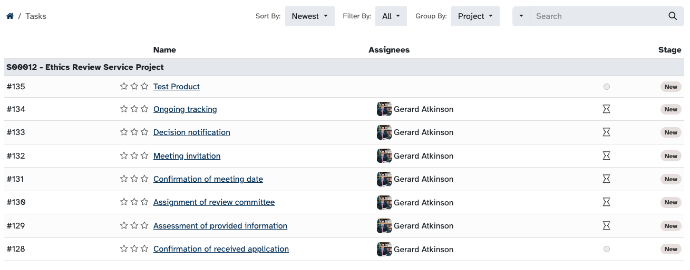
- Log into your Iris Ethics account
- Navigate to "Tasks"
- Select the relevant project
- Go to the "Ongoing Monitoring" task
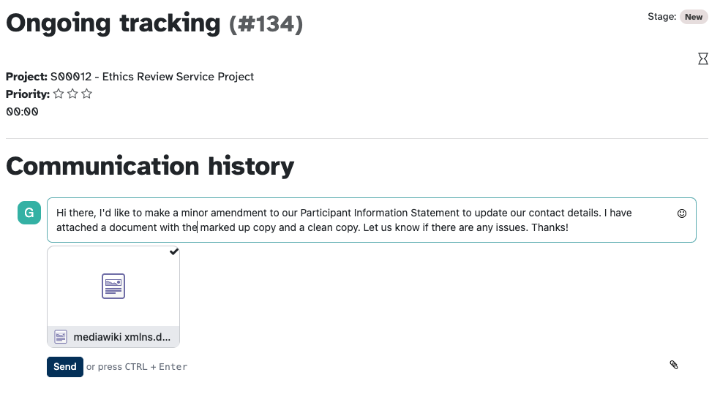
Send us a message outlining:
- The nature of the amendment
- Rationale for the changes
- Any supporting documentation (attach files to your message)
Picture guide:

What to include with your amendment
Provide clear documentation to support efficient review:
- Summary of changes: Brief explanation of what's changing and why
- Updated documents: Any previously approved documents that have been modified (e.g., consent forms, participant information sheets, interview schedules)
- Version control: Ideally, provide both clean and tracked-changes versions of updated documents. This helps reviewers quickly identify what's changed
- New materials: Any entirely new documents or instruments
If in doubt, include it. Extra documentation rarely slows review, but missing information always does.
Multiple changes
Where practical and not constrained by timeframes, we recommend that you bundle changes into a single amendment submission rather than submitting separately. This provides reviewers with the full picture of how your project is evolving and saves time and money for you.
Approval process and timing
Our position is that under the National Statement (paragraphs 5.2.19(f) and (g)), researchers must obtain amendment approval before implementing changes. Whilst this requirement is not explicitly stated in the National Statement, this requirement is implicit in the monitoring framework established in Chapter 5.4 and consistent with the principles of the National Statement.
We aim to review amendments within 10 business days, consistent with our service charter. You will receive formal written notification of the committee's decision. If our committee identifies issues or needs clarification on the amendment, we'll reach out to you before making a final decision.
An important note on safety concerns: If urgent safety issues arise requiring immediate changes to protect participants, activities should cease pending review (consistent with National Statement paragraphs 5.4.11 and 5.4.15-5.4.17). Contact us immediately if you're in this situation.
Summary
Amendments aren't meant to be bureaucratic obstacles. They're a mechanism for maintaining ethical rigour as your work evolves. By seeking independent review when your project changes, you're:
- Protecting participant welfare through external oversight
- Maintaining research and evaluation integrity and alignment with what was approved
- Catching potential issues before they become problems
- Demonstrating commitment to ethical practice beyond mere compliance
Get in the habit of thinking "Does this change warrant amendment?" rather than "Can I get away without submitting this?" The former mindset serves your participants, your research quality, and your professional reputation.
If you're uncertain whether a change requires amendment or whether it's minor or major, contact us either through the portal or at [email protected]. We'd rather have a quick conversation than have you either proceed with unapproved changes or delay unnecessarily.
Related resources
This page was last updated on 10 September 2026.
Was this helpful? We'd appreciate your feedback!
This article makes reference to the National Statement on Ethical Conduct in Human Research 2025. It is intended as practical guidance and does not constitute legal advice.
AI Disclosure: Resources in this library were prepared using Large Language Models with input from Iris Ethics staff who guided the scope and design. Subsequent revisions and final versions were developed and approved by Iris Ethics staff.